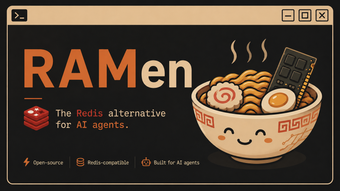
Redis-compatible in-memory store with native vector search
RAMen, by Rohit Dnath, is an in-memory data store built to support AI-driven workflows and agent memory. The tool accepts key-value style access while adding semantic retrieval so applications can fetch content by meaning instead of exact matches. It targets AI developers and backend engineers who need a local store to reduce latency and avoid repeated model calls, and integrates with agent ecosystems that use a protocol for model context exchange.
What tasks can you actually use it for?
The tool functions as an in-memory store that merges Redis-style access with vector and semantic retrieval for AI workloads. It accepts Redis protocol commands, exposes semantic caching for meaning-based lookups, and runs a Model Context Protocol server that agents can query directly. The core implementation is written in Go and optimized for in-memory performance, so use cases include fast local retrieval for agent memory, session context, and cached LLM answers.
How accurate is semantic retrieval for AI workflows?
Semantic caching stores and retrieves AI answers based on meaning rather than exact keyword matches, a design intended to reduce LLM calls and lower latency during retrieval. The native vector search handles high-dimensional embeddings to support those lookups. Outputs reflect the index and embedding quality, so teams should validate cached responses against their application data before relying on them for factual or high-stakes decisions.
What environments and clients does it support?
The distribution model is a single Go binary, which simplifies deployment across systems that can execute Go programs. The tool implements a drop-in Redis protocol so existing Redis clients and codebases can interact without significant modification. For agent workflows it integrates with any AI client or platform that supports the Model Context Protocol, with named examples including Claude Desktop and Cursor, enabling direct data access from agents.
Is it easy to adopt in existing stacks?
Adoption centers on developer ergonomics and open-source readiness. The BSD-3-Clause license and a GitHub-hosted project make code reuse straightforward, and the developer's background in backend systems, Node.js, TypeScript, and Go suggests an emphasis on API and deployment discipline. Because the tool targets engineers and AI agent builders, expect a development-oriented workflow that favors repository integration, code-level configuration, and iterative testing rather than graphical administration.
Who should consider this tool
The tool is a pragmatic choice for engineering teams building agent-backed services who need local retrieval and developer control. Its open-source orientation supports repository-driven integration, but teams should validate semantic-cache outputs against their datasets and confirm their agents can access the store via the required context protocol before deploying at scale. Treat it as an engineering component, not a plug-and-play end-user product.